

 facebook
 Whatsapp
 Email
Email
 Link
Link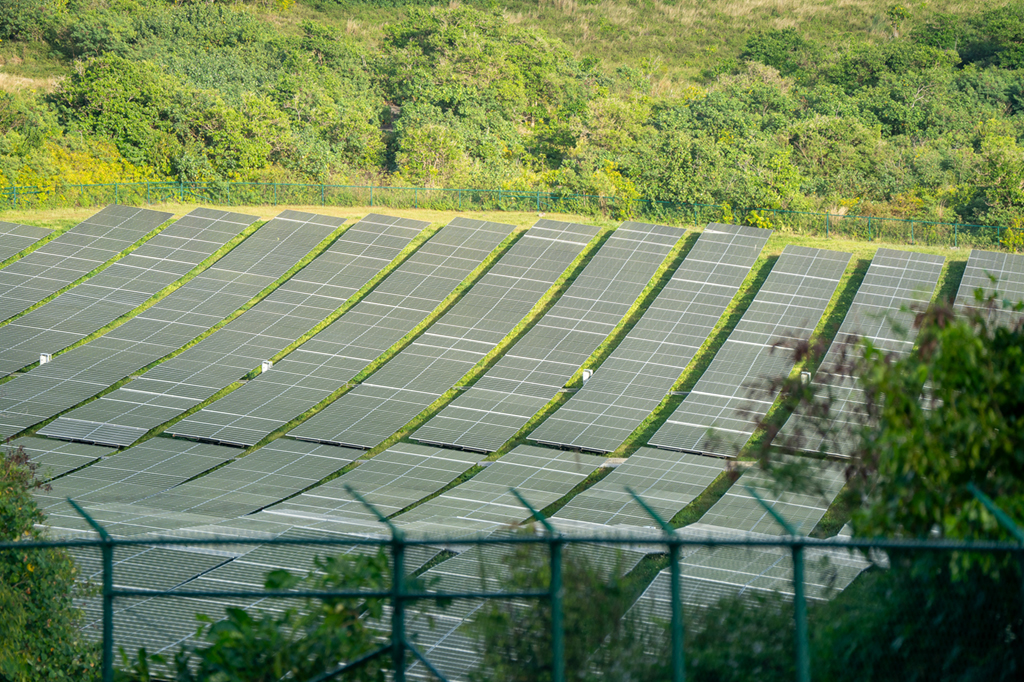
Photo by Skyler Obispo
By Skyler Obispo
Power across Guam, the Northern Mariana Islands, Palau, and the Federated States of Micronesia are contending with rising temperatures, aging infrastructure, surging demand, and the constant threat of typhoons. The need for reliable power services is more urgent than ever, particularly in the face of economic pressures mount and the popularity of solar energy grows.
Paul R. Stanko, senior forecaster at the National Weather Service Forecasting Office Guam, told the magazine that the number of tropical cyclones and typhoons are trending downward; a trend seen in other ocean basins around the world except for the North Atlantic.
However, it does not mean the region is completely safe from typhoons. It only takes one typhoon to cause significant damage, says William Brandon Aydlett, a meteorologist with the NWSFO Guam. He points to Typhoon Mawar which struck Guam in 2023 — a year that recorded one of the lowest number of tropical cyclones for an El Niño year. Typically, during an El Niño period, the region would see an increase in tropical cyclones, he explained.
Typhoon Mawar caused substantial damage to Guam Power Authority’s system and most of the island without power — some customers for months.
The devastation of Mawar underscored the vulnerability of island infrastructure and the ongoing need to harden infrastructure and improve resilience.
GPA's Cabras 1 and 2 were commissioned in 1974 and 1975, respectively. They were slated for decommissioning in 2024 as GPA brings the new Ukudu power plant online. However, Mawar damaged Ukudu power plant, delaying the completion and is now slated to open sometime later this year to early next year. The Cabras units can provide a combined 132MW of power. Ukudu is being built to generate up to 198MW.
The Ukudu plant was also designed with resiliency in mind according to Larry Johnson, a principal electrical engineer and senior project manager at Stanley Consultants, an engineering firm contracted for the Ukudu power plant project since 2017.
Johnson said the plant was built with heavy duty steel to withstand natural disasters.
“It’ll take a typhoon fine,” he said. “This is strong stuff. It’s not going to move.”
In the meantime, GPA struggles to meet Guam’s growing power needs, resulting in load shedding and concerns about reliability, particularly during peak hours. Unseasonably high temperatures in 2025 drove electricity demand to a record 265 MW. Earlier in the summer, GPA called on customers to conserve power to meet demands and avoid rolling power outages.
Over the years, there’s been a substantial push for green, clean energy. In 2024, GPA received at least $64.3 million in federal funding for solar energy and grid modernization programs. This is all part of GPA’s wider Guam Energy Master Plan, a goal for Guam to transition from fossil fuel fired generation to renewable energy and non-greenhouse gas emissions within the next 15 years.
GPA said that its goal is to provide 50% of the island’s electrical power from renewable energy by 2030 and 100% by 2040. As of July 2025, the island is currently at 16% renewable energy generation. GPA has generated 85.3 MW in renewable energy according to recent data.
According to February to April 2025 Guam building permits published in the June 2025 issue of the Marianas Business Journal, 32 permits were issued for solar installations across residential addresses.
The Commonwealth Utilities Corp. in the Northern Mariana Islands faces similar challenges, compounded by a smaller, more dispersed population, manages aging infrastructure. There are five power generation facilities. Saipan has the three: Power Plant 1, the largest, was designed with eight power units totaling 86MW; Plant 2 with four engines with 10 MW; and Plant 4 has six engines of which only two are operational with 16 MW, according to the CUC website.
A key problem is CUC's outdated power generation equipment, particularly at Saipan's Power Plant 1 and 4. Some components are more than 50 years old, according to a 2019 Citizen-Centric Report, severely reduced available power. Saipan's grid was supplying only about 56 megawatts, leaving a significant gap in meeting peak demand, a report by the Pacific Power Association noted after Super Typhoon Yutu in 2018. The storm itself caused widespread damage to the power grid.
Like Guam and other islands in the region, financial pressures weigh heavily on CUC. The NMI’s electricity is almost entirely generated using imported fossil fuels, making the corporation vulnerable to volatile global oil prices, as highlighted by the National Renewable Energy Laboratory. High fuel costs translate to high electricity rates for consumers, which can in turn affect CUC's revenue. Adding to the strain, the NMI government has owed CUC substantial amounts for unpaid utility bills. In a move to address this, the NMI Governor and CUC signed an agreement to offset $10.9 million in arrears. These financial difficulties have even led to the cancellation of employee bonuses and stalled critical equipment replacement projects.
Looking to the future, CUC is pursuing a multi-faceted approach to bolster power generation. Immediate plans include replacing and upgrading existing diesel generators. A new 8.7-megawatt generator for Saipan Power Plant No. 1 is expected to be commissioned in early 2025, and two more generators (5-6 MW) for Power Plant No. 4 are in the procurement phase, CUC's 2024 Citizen-Centric Report states.
Beyond these immediate fixes, CUC is committed to transitioning to renewable energy. The corporation has signed the Blue Planet Alliance agreement, aiming for 100% renewable energy by 2045, aligning with the NMI government's goal, the CUC's 2024 report states. This involves developing utility-scale solar farms, with initial property acquisition for a 20-megawatt solar system already underway, the report adds.
CUC is also exploring advanced technologies like battery energy storage systems to stabilize the grid and integrate intermittent renewable sources. Additionally, CUC is investing in transmission and distribution system upgrades, replacing wooden power poles with more resilient concrete ones and planning underground distribution projects to improve the grid's ability to withstand natural disasters and accommodate renewable energy, details of which are outlined in CUC's 2024 Citizen-Centric Report. These initiatives are largely supported by substantial federal grants from agencies like the U.S. Department of the Interior-Office of Insular Affairs, U.S. Department of Energy, and FEMA.
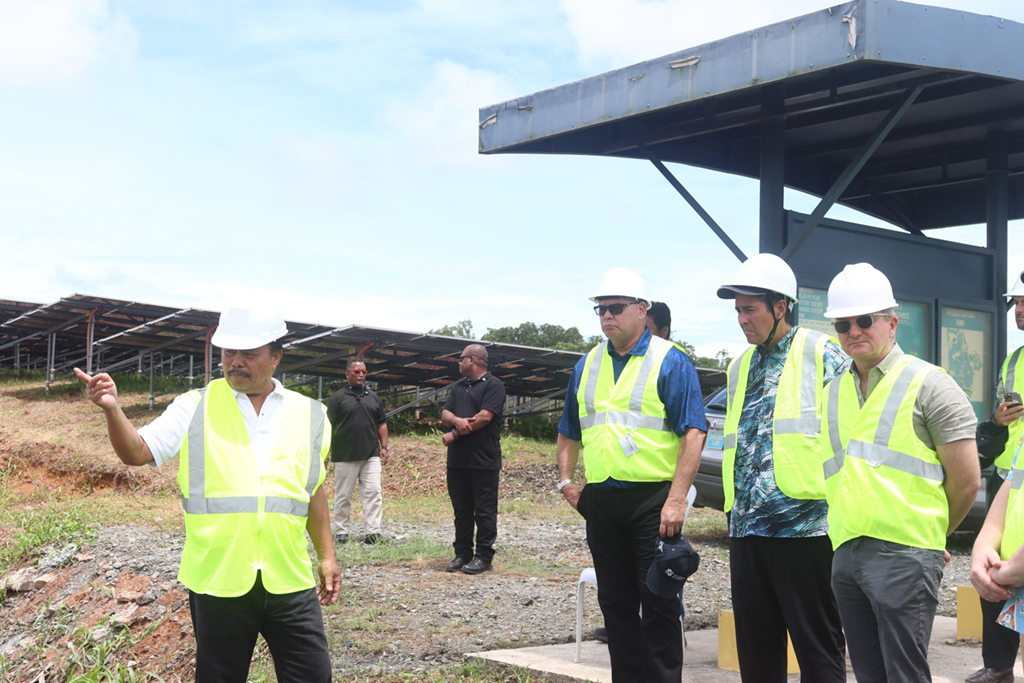
Photo courtesy Office of the President
The Federated States of Micronesia faces its own set of energy challenges, shaped by vast geography and economic constraints. According to the FSM’s National Energy Policy 2024-2050, the nation spends about $50 million annually on fuel imports—nearly 15% of its GDP.
President Wesley W. Simina highlights, “This financial strain is compounded by concerns about energy security, largely due to our geographical nature, spreading over 65 inhabited islands across 1.5 million square miles.”
In the Federated States of Micronesia, solar energy has become more attractive due to an environmentally-conscious political stance and rising costs.
In the FSM’s National Energy Policy 2024-2050, President Wesley W. Siminia wrote that the FSM spends approximately $50 million annually on fuel imports, nearly 15% of the country’s gross domestic product.
“This financial strain is compounded by concerns about energy security, largely due to our geographical nature, spreading over 65 inhabited islands across 1.5 million square miles,” he said.
Like Guam, the FSM strives to have renewable energy comprise a majority of its electricity generation; aiming to have about 70% by 2030.
However, there are challenges associated with this endeavor, one is cost.
According to the policy, the cost of renewable energy technologies have yet to offer significant cost advantages over traditional diesel power. Furthermore, the FSM is facing challenges to attract private sector investors to the region compared to larger markets.
Moreover, diesel provides fast and secure sources of electricity during emergencies like natural disasters.
Palau’s power system has faced similar challenges with aging infrastructure, increasing number of stronger storms, reliance on foreign fossil fuels. There’s an ongoing project with the government of Japan to replace old power poles and hardware along Compact Road in Babeldaob, the big island of Palau’s archipelago. A second project looks to improve the nation’s power grid and ease the switch between diesel fueled generators and the energy from the Ngatpang solar farm.
It’s efforts to transition to renewable energy has faced challenges but is moving forward. President Surangel S. Whipps, Jr. and his predecessors have worked with the Palau Public Utilities Corp. to explore various clean energy options over the years. With the partnership of several partners, more homes and businesses in Palau have installed solar panels. A reported 30% of Palau’s energy is provided by rooftop systems during the day. Most, if not all of these systems, rely on the PPUC grid for power at night. Former President Thomas Remengesau, Jr. had finalized a deal to build the Ngatpang Solar Farm, in partnership with the Australian government. The plant has a capacity of about 15 MW solar with 12.9 MWh battery storage.
While this was a significant step towards renewable energy for the nation, the solar farm faces several challenges related to its battery storage system, primarily stemming from the interplay between a large-scale renewable project and an existing grid that wasn’t designed for it, officials have said.
More recently, on July 10, Whipps toured the solar farm with Australian officials and PPUC leadership. Solar Plant Manager Tito Cabunagan highlighted the farm’s contribution to offsetting fossil fuel use and Palau’s growing clean energy capacity. Whipps emphasized that integrating battery storage — an effort underway with support from Australia at the Ngatpang solar facility — will significantly boost clean energy usage, help households save money, and move Palau closer to its net-zero emissions goal.
Editor Oyaol Ngirairikl contributed to this report.