 facebook
 Whatsapp
 Email
Email
 Link
Link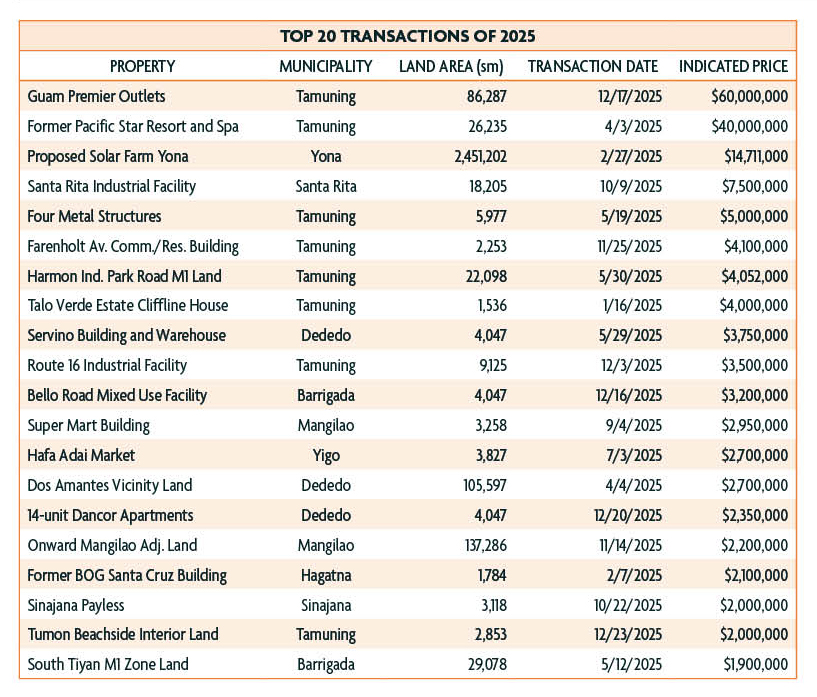
By Siska Hutapea

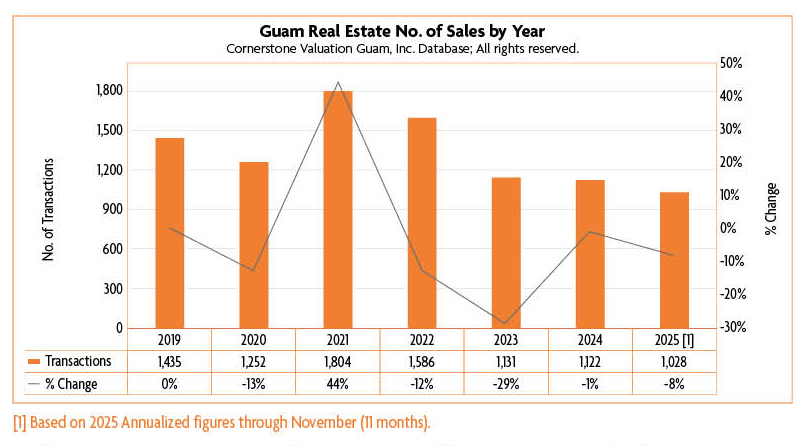
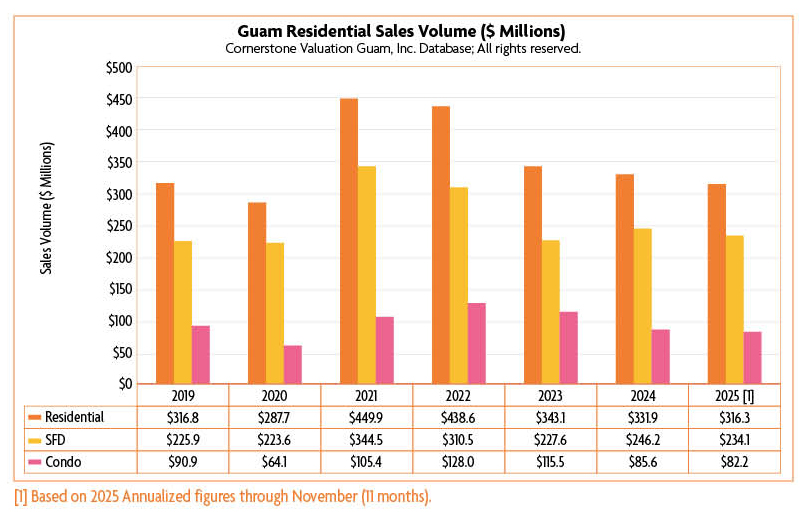
Nothing summarizes our island economy better than Guam’s real estate market, so said a real estate advisor. The majority of buyers involved in 2025 real estate sales were parties tied to military-related construction.
The tourism market remains substantially below the 2019 peak. Year-to-date (through October 2025) tourist arrivals totaled 615,660, a mere 45% of the same period in 2019 when 1,365,270 arrivals were recorded. The strong U.S. dollar remains a stumbling block to recovery, which had been perceived as underway prior to Typhoon Mawar. Despite these statistics, fiscal 2026 appears to have started off on a positive note, with October 2025 arrivals up by 16.6% from Korea and 28.8% from Japan. The Guam Visitors Bureau provided three arrival forecast scenarios for fiscal 2026: a conservative estimate at 739,051, a moderate estimate at 874,517, and an optimistic one at 1,009,981.
The Korea Fair Trade Commission’s approval of the Korean Air and Asiana Airlines merger has inadvertently created the phenomenon of “lie-flat economy” flights. As a condition of the merger, the combined entity is required to maintain at least 90% of the seats supplied in 2019 on 40 routes. Despite the abundance of seats, arrivals from Korea remain weak. There has, however, been an uptick in Japanese arrivals in 2025.
On the bleaker side of the tourism market is the planned closure of Guam’s T Galleria by the DFS Group in March. The shutdown of this prominent facility, located at the heart of Guam’s tourism center in Pleasure Island, will have ripple effects throughout the local economy. Retail is unfortunately expected to remain weak until tourist arrivals increase or new products — such as additional outlet stores — enter the market.
Worldwide changes in the luxury retail industry have forced closures, including stores in Sydney and Melbourne. The Waikiki DFS closure was announced in early January. DFS will reportedly also close its stores at Honolulu and Kahului airports this year.
The military buildup remains strong. In addition to the $8.3 billion Marine Base Camp Blas project, a $15 billion contract was awarded in September 2025. Naval Facilities Engineering Systems Command Pacific awarded a combined $15 billion indefinite-delivery/indefinite quantity design-build multiple award construction contract on Sept. 10 to several companies to support construction projects primarily in Guam and other areas under NAVFAC Pacific’s cognizance. This mega contract includes design-build and design-bid-build renovation, additions and upgrades, and new construction for barracks and dormitories; administrative, communications, educational, medical, dental, and hospital facilities; industrial and warehouse facilities; ranges; operational and training facilities; roads, bridges, utilities and infrastructure; dredging; aviation facilities; and other base development projects. The work is expected to be completed by September 2033 — an extremely short time frame given the scale.
The industrial market emerged as the primadonna of Guam’s 2025 real estate sector, driven by demand in warehousing and housing for temporary workers. A bill currently on the floor would make temporary worker housing an allowed use, rather than a conditional use, in the M-1 Light Industrial Zone. This change is expected to shorten permitting timelines and reduce the need to use apartment units for H-2 workers, thereby releasing those units back to local residents.
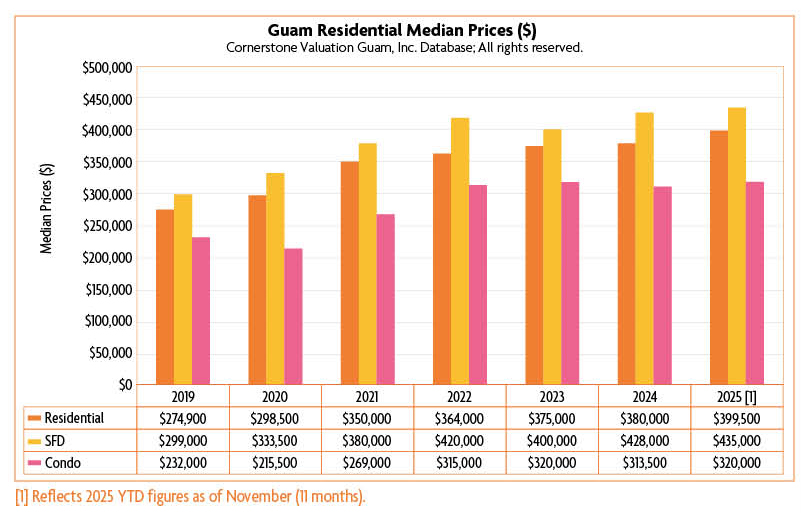
NAVFAC Pacific and Joint Region Marianas issued a Request for Information seeking proposals to expand military housing capacity on Guam in response to Indo-Pacific force posture realignment, particularly the relocation of U.S. Marine units from Okinawa, Japan. The RFI noted that active-duty personnel levels, which stood at 17,000 in fiscal 2024, are projected to reach 24,000 by fiscal 2033. It further stated that by 2033, an additional 1,600 family housing units and 800 unaccompanied housing units will be required. Reportedly, 140 submissions were received by the October 2025 deadline. Phase II of the RFI was expected to be announced in November but has been delayed due to the government shutdown.
Federal expenditures experienced a hiccup due to the government shutdown. More broadly, market participants expect a general reduction in federal spending. However, who would have anticipated the proposed deep-sea mining in the Mariana Islands? The federal government, through the Bureau of Ocean Energy Management, issued a call for interest and information on potential leases for commercial mining offshore Guam and the NMI. This will include approximately 35.5 million acres of sea floor east of the Mariana Islands.
On a more positive note, Guam is seeing the emergence of a new industry through the Guam Additive Materials and Manufacturing Accelerator Applications Center. GAMMA operates from an 8,000-square-foot concrete warehouse at Pacific Industrial Park near Route 3 in Dededo and is designed to 3D-manufacture hard-to-procure parts for Navy ships and submarines. The University of Guam is in the process with the Colorado School of Mines of developing technical expertise to support this 3D manufacturing industry. A proposed facility is to be built to allow local government and private sectors users in Guam to access 3D printing technology.
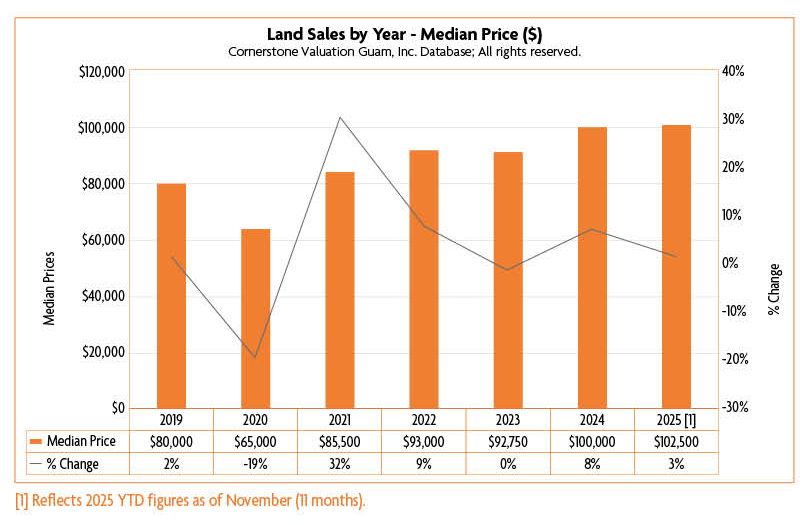
Guam is a major hub for fiber optics and communications. Additional data centers are expected to be built, although their viability will depend on the availability of lower-cost power.
Real estate demand over the next five to 10 years is expected to be driven primarily by the military buildup, which shows no signs of slowing down. Rising construction costs remain a significant barrier to new supply and have made existing properties increasingly attractive to buyers. Infrastructure development will be key in the coming years to ensure sustainable growth for Guam.
If you have teenagers or young adults in your household, the title of this article may have caught your attention. End of Beginning is a song by Djo — also known as Joe Keery, who played Steve Harrington on the hit TV series Stranger Things. The lyrics offer a powerful reflection on nostalgia, identity, and the inevitability of change. Much like Guam’s tourism market, I often find myself comparing today’s data to the 2019 peak. Perhaps the better approach for Guam is to shift our mindset. Rather than anchoring ourselves to the 2019 peak, we should look ten years ahead — take inventory of our capabilities, identify what kind of economy and community we want to build, and plan accordingly. At the same time, we must focus on what can be done in the next hour: the practical, immediate actions that move us closer towards those long-term goals. Progress will not come from waiting for a full recovery or a single transformative event, but from consistent, deliberate efforts made every day that, over time, shape Guam’s next chapter.