


 facebook
 Whatsapp
 Email
Email
 Link
Link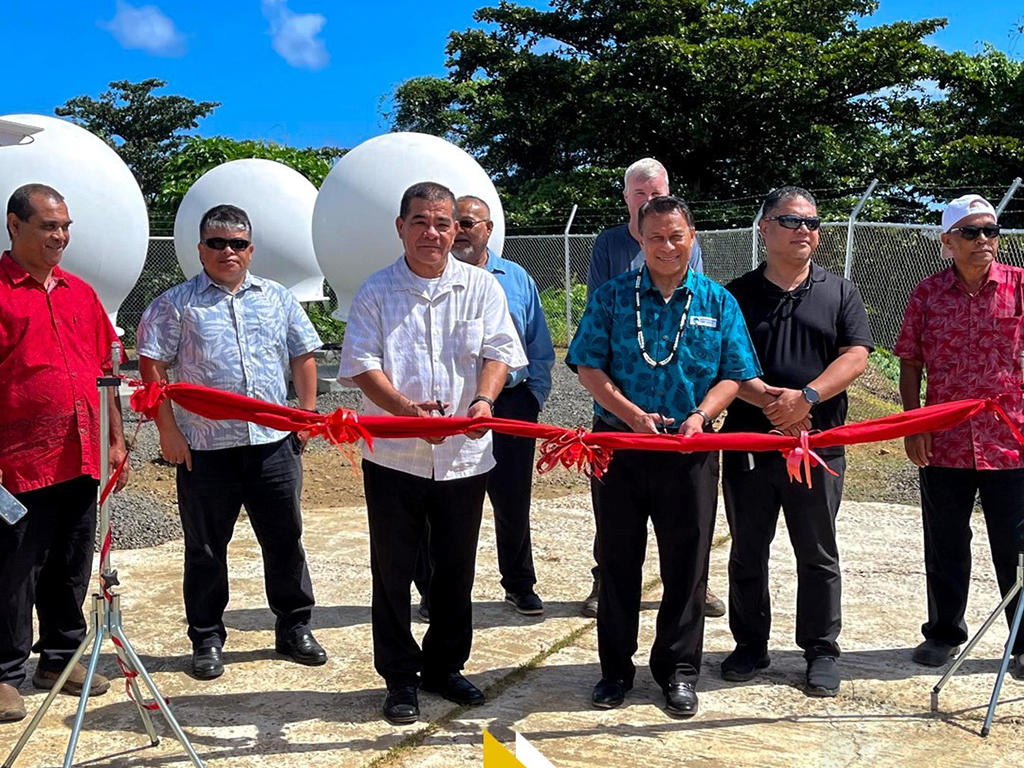
Photo courtesy of the Office of the President
By Oyaol Ngirairikl
In the vast and scattered expanse of the western Pacific, island regions like Guam and the Northern Mariana Islands — though far removed from any continental landmass — have leveraged strategic partnerships to overcome their connectivity challenges.
Guam, though thousands of miles from major cities, has 12 submarine fiber optic cables connecting it to the U.S. mainland and Asia. Thanks to Google’s $1 billion “Pacific Connect” initiative and the anticipated Proa and Taihei subsea cables landing in Guam, the NMI, Japan, Hawaii, Fiji, and French Polynesia, both territories are emerging as critical internet nodes linking isolated communities to the global backbone. Helping Guam and the NMI bring the benefits of Guam’s multiple fiber connections to their respective populations, are federal grants under the National Telecommunications and Information Administration. The story in Guam and NMI contrasts with island nations like Palau and the Federated States of Micronesia with populations that live in far-flung islands that make fiber connections cost-prohibitive.
For the western Pacific nation of Palau, which only got its first cable in 2017, there’s been a lot of growth with more to come, says Simon M. Fraser, CEO of Palau National Communications Corp. For Palau, connecting people throughout the archipelago is a challenge. Running fiber hundreds of miles underwater to remote islands would cost millions of dollars. Currently, they’re able to connect islands to the north like Kayangel or southern islands like Angaur, via microwave. PNCC is working on key projects to bring high-speed internet and mobile data to all states, including fiber-optic connections and upgrading mobile networks with extended coverage to the southwest states of Sonsorol and Hatohobei.
Fraser says they’re anticipating breaking ground on a project to provide fiber connectivity to homes and businesses in just a couple of months. PNCC was awarded $35 million by the U.S. Department of Agriculture ReConnect Loan and Grant Program, which furnishes loans and grants to provide funds for the costs of construction, improvement, or acquisition of facilities and equipment needed to provide broadband service in eligible rural areas.
The final project specs design work was being finalized to be submitted to the U.S. partners for approval in the beginning of July. They anticipate a response withing about six weeks, he said. Once approved, they’ll issue requests for proposals and select contractors. The project is expected to take about two years.
On the mobile networks side, Fraser says they’re building a mobile 4G/5G standalone open RAN network, following open RAN principals “because that is where the industry is going.”
“That’s where 6G is going, it will be in these open interfaces,” he says. “We’re also building a 5G standalone network and that’s an important distinction.”
A non-standalone uses a 4G core to deploy 5G services, he explains. The real difference between a non-standalone vs the standalone that PNCC is building comes into play when you look at what a 4G vs 5G core can do, such as ultra-low latency required for medical procedures or operate a swarm of drones for delivery services.
“All of that sort of ultra-low latency is only possible with 5G,” he says. Another example would be using internet of all things, more commonly referred to as “IoT”, devices for oceanic graphic monitoring by providing real-time data on various environmental parameters. These devices, often deployed on buoys, underwater drones, or attached to marine animals, can measure and transmit data on water temperature, salinity, pH, dissolved oxygen, and more, aiding in climate change studies, pollution monitoring, and wildlife tracking. It can also be used to track soil for agricultural studies, he says, adding that the uses for studies that propel Palau’s future could be tremendous.
“All of that can be done with 5G non-standalone,” Fraser says, adding, “What we’re doing is real 5G, effectively.”
He said Palau was the first country in the world to operationalize a direct device satellite service through partner Lynk Global. This capability was started almost two-years ago, Fraser says, adding it was an earlier indicator of Palau’s move to be a frontrunner in the Pacific.
Lynk’s sat2phone technology will eventually help ensure PNCC mobile phone subscribers have connectivity across their whole country. Lynk’s initial Sat2Phone service for Palau will start as a beta service in the Southwest Islands and will be extended to include all remote areas, and Palau’s Maritime Economic Zone, according to Lynk Global’s website. Lynk will also be used to provide back-up services, when natural disasters knock out the ground network, to enhance network resilience in this archipelago nation. Following up on improving connectivity throughout the archipelago, PNCC is currently testing a OneWeb, which was installed early July.
“That is the first OneWeb terminal to be installed in this region,” Fraser says. “We will actually be testing with OneWeb so that they can operationalize that service for the rest of the region so we’re working with them to help them set up their service for this part of the world.”
OneWeb Technologies is a U.S. based subsidiary of Eutelsat Group that delivers secure, end to end commercial satellite communications and wireless solutions—leveraging a combined low Earth orbit and geostationary satellite network to serve government, military, and enterprise clients, according to the company website.
Once the system is up and running in Palau, the goal is to make it available elsewhere, he says. It’s a way to help PNCC earn additional revenue. As he explains it, while they’ve been able to get a lot of help from U.S. grants, as well as Australia and Japan and other allies of Palau, those grants don’t pay for everything. And purchasing and installing hardware and running and maintaining the system for a population of under 20,000 just as telecom providers who serve larger populations.
“We have the same costs as the companies in Guam or Texas, but we have a fraction of the customers,” he says. It is largely because of the nation’s smaller population that no other provider is allowed to come in and compete, according to law. What this means, he says, is PNCC has to be innovative to be able to provide the evolving needs of residents of the archipelago, while also managing costs.
In Guam and the Northern Mariana Islands, local and regional providers have been working to improve their infrastructure and expanding their footprint through investments and new partnerships. But for many, in Guam and the NMI, all eyes were on the federal government, awaiting the changes to the national Broadband Equity, Access, and Deployment program.
The BEAD program, administered by the National Telecommunications and Information Administration, is a federal initiative introduced by the previous Biden administration. It allocates $42.45 billion to bridge the digital divide by funding broadband expansion in underserved areas. Guam was allocated over $156 million in BEAD funding to enhance internet access and affordability. The NMI received nearly $80 million to implement BEAD.
The Commerce Department earlier this year launched a review of the BEAD program. See Guam, NMI press on as feds re-evaluate broadband deployment program.
The National Telecommunications and Information Administration released in June a BEAD Restructuring Policy Notice, which removes numerous regulatory and policy requirements, mandates a new, cost-driven and technology-neutral selection process, and requires all states to revise and resubmit their broadband deployment proposals.
The changes are designed to accelerate deployment and reduce costs, according to the notice.
The Trump administration had criticized the previous administration on focusing too much on fiber connectivity and for its many requirements, which slowed the process.
The notice reflects these concerns and adds, “These reforms are necessary. NTIA nevertheless recognizes that stakeholders have invested significant resources participating in the BEAD Program since IIJA passed in 2021. Accordingly, this Policy Notice carefully balances the work that has previously been done with necessary changes to ensure the success of the BEAD Program. Specifically, NTIA does not require Eligible Entities to repeat the initial stages of the Program but removes the extralegal Biden Administration burdens and promotes greater competition. This targeted approach will ensure that all Americans receive the greatest Benefit of the Bargain and that the BEAD Program moves forward expeditiously.”
The new NTIA changes include:
- Tech-Neutral Approach: Preference for specific technologies will be removed, returning to statutory definitions and allowing fair market competition.
- Labor Requirements Simplified: Only legal compliance certification will be required, removing DEI mandates and centralized labor planning.
- Climate Requirements Eliminated: Climate analysis obligations are dropped; focus shifts to network reliability and resiliency.
- Net Neutrality Mandates Ended: Prior micromanagement and wholesale access requirements on networks are eliminated.
- DEI Coordination Removed: Requirements to consult identity-based or special interest groups are dropped.
- Municipal Broadband Incentives Ended: Preference for non-traditional providers like municipalities is removed to prioritize capable providers.
- Rate Regulation Prohibited: NTIA will reject mandated rate-setting and allow market-based low-cost plans. Middle-class affordability mandates are also scrapped.
- Environmental Review Streamlined: A new NTIA tool to speed up NEPA permitting processes.
In the NMI, the policy changes was a bit of a “hiccup” but they’re rolling with it and anticipate meeting the new requirements and deadline.
"(It) did require our office to pivot and make changes in a very tight timeframe but we are on track … We have 90 days from June 6 to run all the processes required and submit to the NTIA our Final Proposal for their approval,” says Glen Hunter, special assistant for the CNMI Broadband Policy & Development Office NMI has been able to fast track the process to meet the new deadline of September.
Hunter adds even with the “tech neutral stance” the NTIA still requires that the technology that will be prioritized for BEAD funding by the NMI meet the statutory definition of Priority Broadband Project. Hunter explains that Priority Broadband Project means a project that provides broadband service at speeds of no less than 100 megabits per second for downloads and 20 megabits per second for uploads. It has a latency less than or equal to 100 milliseconds, and can easily scale speeds over time to meet the evolving connectivity needs of households and businesses and support the deployment of 5G, successor wireless technologies, and other advanced services.
The new notice also adjusts the scoring rubric to almost primarily base scoring on Cost (BEAD Outlay).
“It has other changes as well,” Hunter says. “We were able to engage directly with NTIA Officials at the NGA Broadband Summit in Ohio in mid-June and discussed our path forward for the NMI. We have made the needed adjustments to our BEAD process in accordance with the June 6 Policy Notice and we have launched our mandated ‘Benefit of the Bargain’ subgrant round and are currently receiving applications for potential subgrantees.”
Hunter adds that by September, his office would have preliminarily selected potential subgrantees for each of the NMI’s Project Funded Areas, and incorporated those selections into their final proposal that we submit by September to the NTIA for final approval. The NTIA has up to 90 days to respond and if the NMI’s proposal is approved then his office can award the subgrants officially.
During the meeting with NTIA acting Director Adam Cassady, Hunter was able to share the NMI’s unique situation.
"He was very receptive to how important this program was to the NMI. Nearly every home and business in the NMI is slated to receive BEAD funded broadband network deployment (the NMI is 100% unserved or underserved). Most states and territories only have a very small fraction of homes and businesses that will receive BEAD funded network deployment. (That’s) a very stark contrast to the NMI,” Hunter said.
The Office of Infrastructure Policy and Development under the Office of the Governor of Guam is also having to pivot but is working to meet the September deadline, says Director Melissa Bettis.
One of the impacts of the changes is her office now has to change from the already prepared request for proposal to an invitation for bid, which has different rules.
“We paused our subgrant process while we were awaiting the new policy guidance and then we had to modify our procurement method from a (request for proposal) to an (invitation for bid),” she says.
“Basically, on Guam, we have only a couple of methods for procurement, an IFB or an RFP for us. But under the new policy guidance we have to base the selection on price, which we can’t do with an RFP,” she says.
“We are bound by the procurement rules on Guam,” she says, adding that while this will take them beyond the aspirational date of July 15 they’re pushing to get the IFB out as soon as possible to beat the new deadline.
Both Guam and Saipan have already had some communications improvements through other funding mechanisms outside of BEAD. In addition, companies also continue to work on their own commitments to improve and expand their services, investing their own millions back into their systems.
The Marshall Islands is making significant progress in modernizing its telecommunications sector, according to government statements.
President Hilda C. Heine, in addressing the United Nations General Assembly at the Summit of the Future last September, emphasized the urgent need for a more effective UN system to tackle pressing global challenges, including the digital connectivity.
“The global digital divide is a major development challenge for our Pacific Islands region – we are some of the most isolated places on earth. We welcome the Global Digital Compact, and highlight our Joint Program to advance digitalization, working with assistance across the UN system,” she told the assembly. She cautioned against the disconnect between ambitious goals and the financial resources required to achieve them, stressing the need for a dedicated focus on Small Island Developing States in global agendas. The Digital RMI Project aims to deliver faster, more reliable, and affordable internet access to all citizens, recognizing the critical role of connectivity in economic and social development.
According to officials, the project includes investments in fiber infrastructure, with the goal of providing fiber-to-the-home in major centers such as Majuro and Ebeye and enhancing services for neighboring islands. The government is also seeking partnerships with private operators to upgrade telecommunications systems, improve customer service, and set new standards for pricing and service quality. The project is ongoing, with continued expansion and upgrades planned through at least 2025, according to government statements and World Bank project documentation.
The Federated States of Micronesia is primarily served by the FSM Telecommunications Corp. and the FSM Telecom Cable Corp. FSMTC, a public corporation, is tasked with providing modern, cost-effective telecommunications services, including telephone, internet, wireless, and cable, to every household in the country. The FSM Telecom Cable Corp. manages the submarine cable network that connects the four states of Chuuk, Kosrae, Pohnpei, and Yap, and is focused on promoting broadband adoption, according to company statements.
On Feb. 21, the corporation successfully installed the Starlink Gateway System on Kosrae Island, and the system is now operational, according to the Office of the President. The commissioning is led by Vice President Aren Palik, and the Governor Tulensa Palik of Kosrae State. With FSM Telecom Kosrae now connected to the Starlink system, the people of Kosrae can benefit from improved connectivity. The World Bank funded the project.